
Choosing Methodologies in Qualitative Research
What philosophies and approaches will frame your online study?

I’m discussing my 2022 book and sharing updated and new materials. If you want to read along, find a discount code to purchase Doing Qualitative Research Online and free library options for the first edition here. Before we turn the page to Chapter 3, let’s think a bit more about methodologies.
First, a reminder of our terminology:
Methodology refers to the philosophies and systems of thinking that justify the methods used to conduct the research. The methodology is a framework that explains why you are conducting the study.
Method refers to the systematic and practical steps used to conduct the study. You choose methods for collecting data, and methods for analyzing and interpreting data.
Sometimes the terms methodology and method are used interchangeably. However, it is useful to differentiate the why, or methodology, and the how, or the methods used to conduct the inquiry. Subscribe to receive future posts that examine decisions about other parts of the research design process.
Multimethod or multimodal research uses more than one method but stays within the respective qualitative or quantitative methodological framework. In qualitative research the term multimodal also refers to studies that utilize more than one type of data. In other words, you can design a study framed with more than one qualitative methodology, and/or more than one method for carrying it out.
Methodologies and Online Research
Qualitative methodologies are complex. To put them in simple terms:
Want to study how to find solutions with a community? Use action research methodologies.
Want to study how the problem manifests in a defined group or situation? Use case study methodologies.
Want to study future possibilities? Use delphi methodologies.
Want to look broadly at a problem? Use exploratory methodologies.
Want to develop new theoretical constructs to explain the problem? Use grounded theory.
Want to study how individuals perceive and experience the phenomenon central to the study? Use phenomenology
Each methodology has multiple schools of thought and variations in practice. Interestingly, ethnographers lead methodologists in exploring ways that studying people when the field is online (!) relates to the methodologies and methods used. We can find writings about digital ethnography, virtual ethnography, online ethnography and Netnography. For the other qualitative methodologies, we have to be creative, apply the design principles I’ve been discussing in this series, and look at examples from published scholarship that used varied methodological approaches in online research. Looking for an opportunity to contribute? Maybe you are the one to write about the progress in and needs for methodological innovation!
Whose perspectives interest you: individuals or groups?
While there is not a firm match-up, considering the scope of the study and unit(s) of analysis can help you think about which methodology fits the research you have in mind. Some methodologies are more aligned to the study of the individual’s lived experiences, while others are more generally used to study how people interact, make decisions, or get things done in communities, organizations, or society at large.
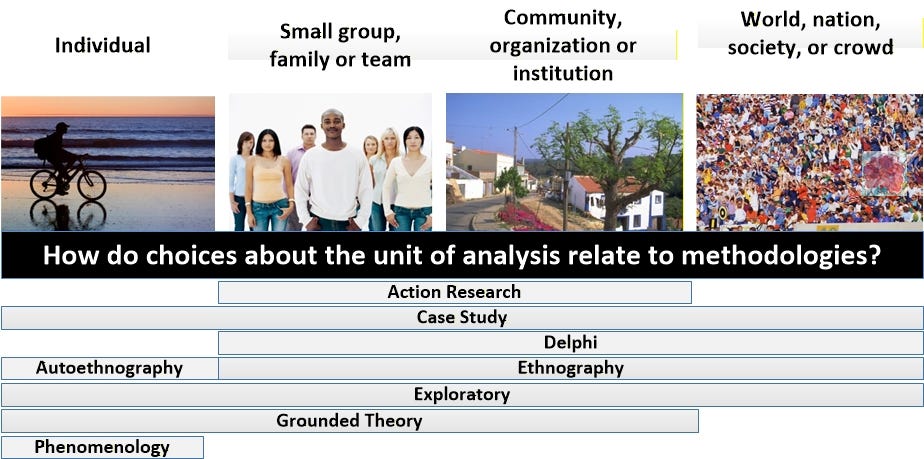
Globe, Society or Crowd. Researchers at the broadest level are interested in global, societal, or cultural issues. These researchers want to understand major trends and common or divergent experiences of a large group or crowd of people. They may be interested in systems or events that touch many lives. They are interested in regions of the world, in specific countries, or in online communities that engage people from across the globe. Topics might include political, social or environmental events or crises, poverty, epidemics, immigration, multinational business operations, economic developments, social movements or the environment.
Policy-makers, experts including scientists and researchers, thought-leaders, or representatives of different segments of society can help us understand large-scale issues. Case study, delphi, ethnography, or exploratory methodologies could help frame the study.
Community, Organization or Institution. At the next level of analysis researchers are interested in one or more communities, organizations, institutions, agencies and/or businesses. While this category may also involve large groups of people, they operate within some shared set of parameters. Researchers want to understand the systems, roles, policies, practices or experiences of those who are more working, learning or living together within some shared set of policies or norms. Topics might include reform efforts, social responsibility, management or leadership styles, or acceptance of change.
Group, Family or Team. On a smaller scale, when researchers study groups, teams or families they are exploring relationships, interpersonal dynamics, and interactions among people who know each other. Topics might include communication or collaboration styles or practices, conflict resolution, parenting or family issues.
In addition to the kinds of knowledgeable individuals mentioned above, community, group, or team members or employees at all levels can provide useful perspectives. Action, case study, delphi, ethnography, exploratory or grounded theory methodologies could help frame the study.
Individuals. At the most fundamental level, qualitative researchers study attitudes, perceptions, or feelings of individuals. Topics could include any aspect of the lived experience. For studies where the units of analysis are small-groups or individuals, the researcher might want a methodology that allows for studying interactions, and data collection methods that include direct contact with individuals.
The insights and perspectives of individuals call for more intimate methodologies including phenomenology or, when the researcher studies their own experiences, autoethnography.
Learn More with Open-Access Articles and Posts:
Reading across disciplines is valuable when we are learning about methodology and methods. This curated collection contains online and on-site examples. I hope they will help you think about new possibilities. While in the virtual stacks, please know that in the Sage Journals database I’ve tapped for these articles, you can select “open access” in the search if you do not have library access.
Methodologies and Design
Roller, Margaret R. 2024. The Essential Human Component in Qualitative Research.
Roller, Margaret R. 2020. Methodology: 26 Articles on Design Considerations in Qualitative, Quantitative, & Mixed Methods Research.
Action Research
Ask those experiencing the research problem before designing a study
Ethics and Engagement with Stakeholders: Interview with Prof. Lesley Wood and Facilitating Community-based research – Starting with ourselves. Tips from Prof. Lesley Wood
Abma, T., Kiela, E., Dohmen, M., Bourik, Z., Uzun, D., Verhage, M., Schrijver, J., Campen, C. van, & Bendien, E. (2026). Slowing Down and Speaking up. Navigating Backstage Processes in Participatory Action Research. International Journal of Qualitative Methods, 25.
Abstract. This article explores the researchers’ responsibilities who engage in participatory action research (PAR) based on the values of epistemic justice and social inclusion. We illustrate that the PAR researcher has to deal with unexpected back-stage dynamics. These are typically hard to handle and often brushed under the carpet. We discuss these complex dynamics referring to a PAR study including photovoice with older adults living in precarious situations.
van Meer, P. (2022). Imaginal knowing in action research. Action Research, 20(1), 10-26.
Abstract. This article explores how imaginal knowing can contribute to learning and action research. I relate this to a need for organizations to learn differently for bringing sustainable results that nourish the world. I position imaginal knowing as a reflexive way of being, which informs awareness beyond language and discourse. An arts-based researcher, my paintings are imaginal reflections of lived experience. I found how engaging with the imaginal enables a more profound presence with that experience. This process, which I refer to as growth-in-connection, can generate unexpected insights and learning. For me, artistically expressing imagination became a reflexive practice to deepen understanding and voice. This article consists of a practice-based strand where I share drawings, paintings, and an inquiry into client work. In the other strand, I explore theoretical ideas from Art-Based Method, Critical thinking, Reflexivity and Action Research.
Case Study
Roller, Margaret R. 2024. Case-centered Research: 5 Articles on the Purpose & Usefulness of a Case-centered Approach.
Mcclunie-Trust, P., Jones, V., Winnington, R., Shannon, K., Donaldson, A. E., Macdiarmid, R., Jarden, R. J., Turner, R., Merrick, E., & Andersen, P. (2022). Doing Case Study Research Collaboratively: The Benefits for Researchers. International Journal of Qualitative Methods, 21.
Abstract. Collaborative research teams are an effective strategy to combine the knowledge and skills of like-minded researchers across tertiary education settings and international borders. Research collaborations have the potential to increase research capacity for both individuals and the team alike. The purpose of the study was to explore the experiences and perceptions of a team of seven Australasian nurse academics undertaking a longitudinal multi-site case study. We used a nominal group technique in this deductive qualitative exploratory study. The key findings from this study indicate establishing safe academic relationships is paramount to successful collaborative teams. Collaborative research teams offer opportunities to learn research processes from other members through sharing of expertise and skillsets, together with upholding a positive engagement with technology to ensure full research participation is achievable irrespective of geographical location.
Lin, X. (2024). Using a Student-Developed Case Study Activity for Online Discussion Guided by a Three-Tier Case Method Model. Adult Learning, 35(1), 34-47.
Abstract. This qualitative study examines student learning experiences toward a student-developed case study activity for online discussion guided by a three-tier case method model. Forty-five students were recruited from four online adult education courses. Analysis of students’ feedback shows that this activity leads to students’ positive learning experiences, including provoking critical thinking towards the discussion topic and providing unique resources for adult educators. The student-developed case study activity also helps establish a supportive peer relationship and engages students through analyzing a variety of student-developed cases, as well as interacting with the instructor and exchanging ideas with peers. This study furthermore indicates the potential usefulness of the proposed model as a guide for case study activities in the field of adult education and beyond.
Tessaro, D., & Restoule, J.-P. (2022). Indigenous pedagogies and online learning environments: a massive open online course case study. AlterNative: An International Journal of Indigenous Peoples, 18(1), 182-191.
Abstract. This study is based on a massive open online course titled Aboriginal Worldviews in Education, which was created and instructed using various Indigenous pedagogies. Despite significant pedagogical differences between massive open online course and Indigenous pedagogical learning environments, this study builds the case that various Indigenous pedagogies can effectively be incorporated in a massive open online course. The study found that holistic pedagogies were effectively applied by centering course creation and instruction around Medicine Wheel teachings. The article details the various experiential and self-reflective activities that were applied to the massive open online course, and that were found to effectively address the spiritual, emotional, and physical quadrants of the Medicine Wheel that are normally overlooked in courses that stress intellectual learning. The article also suggests directions for the development and redevelopment of massive open online courses to better include Indigenous pedagogies.
Delphi
Brady, S. R. (2015). Utilizing and Adapting the Delphi Method for Use in Qualitative Research. International Journal of Qualitative Methods, 14(5).
Abstract. The Delphi method is a pragmatic research method created in the 1950s by researchers at the RAND Corporation for use in policy making, organizational decision making, and to inform direct practices. While the Delphi method has been regularly utilized in mixed methods studies, far fewer studies have been completed using the Delphi method for qualitative research. Despite the utility of the Delphi method in social science research, little guidance is provided for using the Delphi in the context of theory building, in primarily qualitative studies, and in the context of community-engaged research (CER). This article will emphasize new and modest innovations in the Delphi method for improving the overall rigor of the method in theory building and CER.
Haven, T. L., Errington, T. M., Gleditsch, K. S., van Grootel, L., Jacobs, A. M., Kern, F. G., Piñeiro, R., Rosenblatt, F., & Mokkink, L. B. (2020). Preregistering Qualitative Research: A Delphi Study. International Journal of Qualitative Methods, 19.
Abstract. Preregistrations—records made a priori about study designs and analysis plans and placed in open repositories—are thought to strengthen the credibility and transparency of research. Different authors have put forth arguments in favor of introducing this practice in qualitative research and made suggestions for what to include in a qualitative preregistration form. The goal of this study was to gauge and understand what parts of preregistration templates qualitative researchers would find helpful and informative. We used an online Delphi study design consisting of two rounds with feedback reports in between. I
Ethnography
Studying Difficult Topics with Netnography: A Four-Part Series by Robert Kozinets
Hussain, A., Park, T., Memon, Z. A., & Meherali, S. (2026). Echoes of the Field: Navigating Emotion and Reflexivity in Focused Ethnographic Research. International Journal of Qualitative Methods, 25.
Abstract. Qualitative fieldwork in emotionally charged and culturally complex settings presents unique methodological and ethical challenges, particularly for early-career researchers. This paper reflects on a focused ethnographic study of adolescent mothers in Pakistan, examining how emotional entanglement, insider outsider positionality, and repetition shaped the research process. Drawing on reflexive memos and field notes, the paper illustrates how participants’ disclosures, silences, and relational cues created “ethically important moments” that demanded care, humility, and flexibility.
Li, L., & Huang, J. (2025). Online discourse and chronotopic identity work: A longitudinal digital ethnography on WeChat. New Media & Society, 27(6), 3596-3617.
Abstract. This article presents a sociolinguistic analysis of online identity construction through the lens of chronotope. Based on a longitudinal digital ethnography spanning 2019–2022, we examined 253 WeChat Moments posts collected from a participant referred to as ‘Green’. Our aim is to understand how individuals with migration experiences tactically draw on multimodal and translingual resources to construct a coherent online persona amid offline mobility, change and discontent.
Palmberger, M. (2025). The Digital Diary: A Mobile, Multimodal, and Participatory Method and Part of Digital Ethnography. International Journal of Qualitative Methods, 24.
Abstract. In this article I introduce the digital diary method as a multimodal, participatory qualitative approach for investigating everyday digital practices within digital ethnography. This method enables participants to document their media practices and daily activities over time by creating digital diaries that incorporate written, audiovisual, and creative elements. By encouraging the recording of multimodal data—including text, images, photos, voice recordings, and videos—the method provides rich insights into participants’ experiences and emotions. These diaries are later collaboratively reviewed and reflected on with researchers, and they offer a platform for both researchers and research partners to gain fresh insights and deeper understandings of the material discussed.
Rabe, T. (2023). Addressing the Methodological Challenges that Cloaked Profiles Pose to Digital Observations. Journal of Contemporary Ethnography, 52(4), 537-558.
Abstract. Although digital ethnographic studies concerned with online misinformation have focused on analyzing the contents shared by “cloaked” profiles (concealed or fake identities), less attention has been given to the epistemological and ontological dilemmas that cloaked profiles pose to digital ethnography. This article deals with these issues by asking: how can digital ethnographers determine who and what we are observing? And how can we conduct online observations when confronted with cloaked profiles? Drawing on field research, this article argues that researchers would benefit from including more critical reflections on the presence of cloaked profiles and learning how to apply digital skills for how to unveil cloaked profiles. Such practices will challenge a commonly accepted ontology that online profiles represent human behavior and enhance researchers’ digital literacy and ability to recognize cloaked profiles. Finally, applying techniques to unveil cloaked profiles will arguably strengthen the hermeneutic process of knowledge production in digital observations.
Exploratory
Heydon, R., McKee, L., Akiwenzie, E., Cooper, E., Johns, B., McKenzie, P. J., McTavish, M., Poczobut, S., Coelho, C. R., Viczko, M., & Zhang, Z. (2025). Reading and Equity in Teacher Education: An Exploratory Study. Journal of Literacy Research, 57(4), 394-416.
Abstract. Reading is central to higher education, but requires increased pedagogical and research attention. Practice and knowledge gaps have created threats to equity, though the precise nature of the reading/equity nexus in higher education is unknown. The Reading Pedagogies of Equity Project, a professional learning program and study designed with teacher educators, sought to produce insights into equity and reading in higher education. Oriented through critical posthumanism and a speculative pedagogies of qualitative inquiry methodology, the research team generated data with nine teacher educator participants.
Graven, T. (2025). Hearing the city without vision: An exploratory study. British Journal of Visual Impairment, 0(0).
Abstract. This exploratory study explored what sounds people with varying amounts of auditory experience perceive hearing in city soundscapes without vision, and also how these sounds are ranked in order of importance by those with the most auditory experience. Auditory experienced and auditory inexperienced participants without vision participated. The auditory experienced mentioned 2 to 3 times more sounds than the auditory inexperienced; they perceived hearing several aspects of each sound and ranked identity the most important and location the second most important aspect.
Grounded Theory
Makri, C., & Neely, A. (2021). Grounded Theory: A Guide for Exploratory Studies in Management Research. International Journal of Qualitative Methods, 20.
Abstract. Grounded theory was first introduced more than 50 years ago, but researchers are often still uncertain about how to implement it. This is not surprising, considering that even the two pioneers of this qualitative design, Glaser and Strauss, have different views about its approach, and these are just two of multiple variations found in the literature. While studies using grounded theory in management research are becoming more popular, these are often mixed with the case study approach, or they provide contradictory guidelines on how to use it. The aim of this paper is to provide a clear guide for researchers who wish to use grounded theory in exploratory studies in management research.
Mills, J., Bonner, A., & Francis, K. (2006). The Development of Constructivist Grounded Theory. International Journal of Qualitative Methods, 5(1), 25-35.
Abstract. Constructivist grounded theory is a popular method for research studies primarily in the disciplines of psychology, education, and nursing. In this article, the authors aim to locate the roots of constructivist grounded theory and then trace its development. They examine key grounded theory texts to discern their ontological and epistemological orientation. They find Strauss and Corbin’s texts on grounded theory to possess a discernable thread of constructivism in their approach to inquiry. They also discuss Charmaz’s landmark work on constructivist grounded theory relative to her positioning of the researcher in relation to the participants, analysis of the data, and rendering of participants’ experiences into grounded theory. Grounded theory can be seen as a methodological spiral that begins with Glaser and Strauss’ original text and continues today. The variety of epistemological positions that grounded theorists adopt are located at various points on this spiral and are reflective of their underlying ontologies.
Phenomenology
Groenewald, T. (2004). A Phenomenological Research Design Illustrated. International Journal of Qualitative Methods, 3(1), 42–55. https://doi.org/10.1177/160940690400300104
Abstract. This article distills the core principles of a phenomenological research design and, by means of a specific study, illustrates the phenomenological methodology. After a brief overview of the developments of phenomenology, the research paradigm of the specific study follows. Thereafter the location of the data, the data-gathering the data-storage methods are explained. Unstructured in-depth phenomenological interviews supplemented by memoing, essays by participants, a focus group discussion and field notes were used. The data explicitation, by means of a simplified version of Hycner’s (1999) process, is further explained. The article finally contains commentary about the validity and truthfulness measures, as well as a synopsis of the findings of the study.
van Manen M, van Manen M. Doing Phenomenological Research and Writing. Qualitative Health Research. 2021;31(6):1069-1082. doi:10.1177/10497323211003058
Abstract. When looking through phenomenology articles in human science and philosophy journals, we may be excused to get the impression that they offer an inconsistent array of phenomenology publications. In this article, we describe three simple but helpful distinctions for determining some order: first, the great foundational publications; second, exegetical publications in the wake of the great works; and third, phenomenological studies done directly on phenomena. Our aim in this article is not to lay claim to phenomenology as a label but rather to discuss how “doing phenomenology directly on the phenomena and the things” means taking up a certain attitude and practicing an attentive awareness to the things of the world as we live and experience them. We propose that engaging in philosophical exegesis and argumentation is not very helpful for analyzing and explicating originary meanings of experiential phenomena. And we show how doing phenomenology directly on the things can be facilitated by a phenomenologically inspired interpretive attitude as well as by a sensitive talent for employing phenomenological examples.
Multiple Qualitative Methodologies
Bassi, H., Misener, L., & Johnson, A. M. (2020). Crowdsourcing for Research: Perspectives From a Delphi Panel. Sage Open, 10(4).
Abstract. Crowdsourcing, an open call for the public to collaborate and participate in problem solving, has been increasingly employed as a method in health-related research studies. Various reviews of the literature across different disciplines found crowdsourcing being used for data collection, processing, and analysis as well as tasks such as problem solving, data processing, surveillance/monitoring, and surveying. Studies on crowdsourcing tend to focus on its use of software, technology and online platforms, or its application for the purposes previously noted. There is need for further exploration to understand how best to use crowdsourcing for research, as there is limited guidance for researchers who are undertaking crowdsourcing for the purposes of scientific study.
Bayeck, R. Y. (2023). Is Microethnography an Ethnographic Case Study? and/or a mini-ethnographic case study? An analysis of the literature. International Journal of Qualitative Methods, 22.
Abstract. Selecting the research approach that addresses the research question is often challenging for novice researchers. However, getting a better understanding of the research approaches available in the field, is likely to help novice researchers identify and choose the research approach that fits their situation. In this paper, we discuss microethnography, ethnographic case study, and mini-ethnography case study in order to show that these approaches may have similarities but are different. The author hopes that this discussion will help researchers get a better understanding of these approaches and dissipate the confusion that may exist.
Burns, M., Bally, J., Burles, M., Holtslander, L., & Peacock, S. (2022). Constructivist Grounded Theory or Interpretive Phenomenology? Methodological Choices Within Specific Study Contexts. International Journal of Qualitative Methods, 21. https://doi.org/10.1177/16094069221077758
Abstract. Constructivist research methodologies are useful in discerning meanings of experience to subsequently inform and improve healthcare practice. For researchers who philosophically align with the constructivist paradigm, numerous methodologies are available from which to choose to address research questions. However, it can be challenging for researchers, especially novice ones, to choose the most appropriate methodology that aligns with the current state of knowledge of the identified topic, proposed research question, and the study purpose. To reduce the confusion faced by health researchers when choosing an appropriate methodology for a specific study, this paper compares two popular qualitative health research approaches: constructivist grounded theory and interpretive phenomenology.
Bush, E. J., Singh, R. L., & Kooienga, S. (2019). Lived Experiences of a Community: Merging Interpretive Phenomenology and Community-Based Participatory Research. International Journal of Qualitative Methods, 18. https://doi.org/10.1177/1609406919875891
Abstract. Community-based participatory research (CBPR) and interpretive phenomenology, when merged, can provide insight into the experiences of a homogenous community. The purpose of this manuscript is 2-fold. First, we aim to provide a conceptual view of merging methodological approaches of phenomenology and CBPR. Principles of interpretive phenomenology, the philosophical stance, and the qualitative analysis methodology, as well as how interpretive phenomenology is complementary to CBPR, are reviewed. Second, the utility, rationale, and feasibility of merging these diverse approaches are explored. For illustrative purposes, exemplars from a Parkinson’s disease stakeholder study are used to discuss aims, methods, and results.
Cudjoe, E. (2022). Using Diaries With Interpretative Phenomenological Analysis: Guidelines From a Study of Children Whose Parents Have Mental Illness. International Journal of Qualitative Methods, 21. https://doi.org/10.1177/16094069221084435
Abstract. Interpretative phenomenological analysis (IPA) first appeared in publication in 1996 but was introduced as a comprehensive methodology in a first published book in 2009 by Smith, Flowers and Larkin. Since its publication, IPA has seen tremendous application in psychology and cognate social science disciplines. Most IPA studies have used interviews as their primary data collection tool. This is not surprising as semi-structured interviews fit the theoretical foundations of IPA and the authors of the IPA book themselves dedicated a chapter to interviewing. However, the authors have also lamented the lack of the use of diaries in the methodology. Yet, there are scarce IPA studies (or even phenomenological studies in general) using diaries as data collection tool. This is surprising as diaries are amenable with some core elements of phenomenology which IPA ascribes to. The inadequate use of diaries within IPA may be due to the lack of practical insights into what diaries could look like, how they can be obtained or whether they can fit with phenomenology.
Laverty, S. M. (2003). Hermeneutic Phenomenology and Phenomenology: A Comparison of Historical and Methodological Considerations. International Journal of Qualitative Methods, 2(3), 21–35. https://doi.org/10.1177/160940690300200303
Abstract. Hermeneutic phenomenology and phenomenology have become increasingly popular as research methodologies, yet confusion still exists about the unique aspects of these two methodologies. This article provides a discussion of the essential similarities and differences between hermeneutic phenomenology and phenomenology from historical and methodological perspectives. Consideration is given to the philosophical bases, assumptions, focus of research and research outcomes that differentiate these approaches.
Mueller, R. A. (2019). Episodic Narrative Interview: Capturing Stories of Experience With a Methods Fusion. International Journal of Qualitative Methods, 18. https://doi.org/10.1177/1609406919866044
Abstract. Episodic narrative interview is an innovative, phenomenon-driven research method that was developed by integrating elements from several qualitative approaches in a methods fusion. Episodic narrative interview draws on critically oriented theoretical foundations and principles of experience-centered narrative and includes features from narrative inquiry, semistructured interview, and episodic interview. The purpose of episodic narrative interview is to better understand a phenomenon by generating individual stories of experience about that phenomenon.
Suddick, K. M., Cross, V., Vuoskoski, P., Galvin, K. T., & Stew, G. (2020). The Work of Hermeneutic Phenomenology. International Journal of Qualitative Methods, 19. https://doi.org/10.1177/1609406920947600
Abstract. This paper is an illustration of the application of a hermeneutic phenomenological study. The theory of meaning and interpretation, drawing on philosophical hermeneutics and the work of Gadamer and Heidegger, and its alignment with phenomenological thought is presented. The paper explains and aims to make visible how key concerns in relation to the fusion of horizons, hermeneutic understanding, hermeneutic circle and hermeneutic phenomenological attitude were implemented. The purpose is to provide practical guidance and illustrate a fully worked up example of hermeneutic phenomenological work as research praxis.
Some of my favorite books about methodology:
Action Research
Action Research Fifth Edition (2020)
by Ernest T. Stringer, Alfredo Ortiz Aragón
Preview two open-access chapters here.
Critical Participatory Inquiry: An Interdisciplinary Guide (2023)
Meagan Call-Cummings, Giovanni P. Dazzo, Melissa Hauber-Özer
Preview two open-access chapters here.
Case Study
Case Study Research and Applications Design and Methods, Sixth Edition (2017)
Robert K. Yin
Ethnography
Crafting Ethnography (2022)
by Paul Atkinson
Hybrid Ethnography: Online, Offline, and In Between (2020)
by Liz Przybylski
Phenomenology
Introduction to Phenomenology
by Cheryl Tatano Beck (2020)
Phenomenological Research Methods
by Clark Moustakas (1994)
Doing Phenomenography (2024)
by Amanda M.L. Taylor-Beswick and Eva Hornung

This license enables reusers to copy and distribute the material in any medium or format in unadapted form only, for noncommercial purposes only, and only so long as attribution is given to the creator.

Thanks to Beth Spencer for this badge, indicating that no AI tools were used to create this post!