We’ve been exploring the design thinking behind research design in this year’s newsletters. Don’t panic if you have missed anything, because the archives of When the Field is Online are open-access.
We are drawing on my 2022 book, Doing Qualitative Research Online (find a discount code and library access information here.) I’m also sharing updated material and models along the way. If you teach or guide researchers you will find additional resources and instructional materials as a paid subscriber.
Join me for a Qualitative Research Connect webinar: Digital Ethnographic Methods in a Changing World Register here.
Don’t miss anything, subscribe! More resources for paid subscribers.
Chose Information and Communications Technologies That Fit the Research Design.
Let’s turn the page and start exploring Chapter 3 in Doing Qualitative Research Online titled “Choosing Information and Communications Technologies That Fit the Research Design.” I’ve updated my thinking on these topics since I wrote the chapter, which you’ll see in coming newsletters. In particular, issues associated with data privacy and protection are now at the top of my priorities and I’ll dedicate a future newsletter to a discussion of options.
The 2022 publication date signals that this book was written before the release of Generative AI tools. Nevertheless, I continue to focus on technologies that support human work and human-human exchange. There are many reasons why I feel these LLMs and generative AI tools are exploitive and ethically-challenged but suffice to say that I do not and will not use tools built on words and artwork stolen from writers like me. I will not discuss or advocate their use. We have our own intelligence; let’s use it in our research!
What are “information and communications technologies or ICTs”?
I prefer this broad term versus simply saying “online.” For example, information technologies can be used to read and write whether or not we are connected to the Internet. When I discuss communication technologies, I am referring to digital tools that facilitate exchange between humans. Almost any ICT can be adapted for activities associated with qualitative research: to observe activities, record events, write about and share stories, access or download posted content, manage and analyze data. In this newsletter we will focus on ICTs for communication, collaboration, and exchange used to collect data from and with human participants.
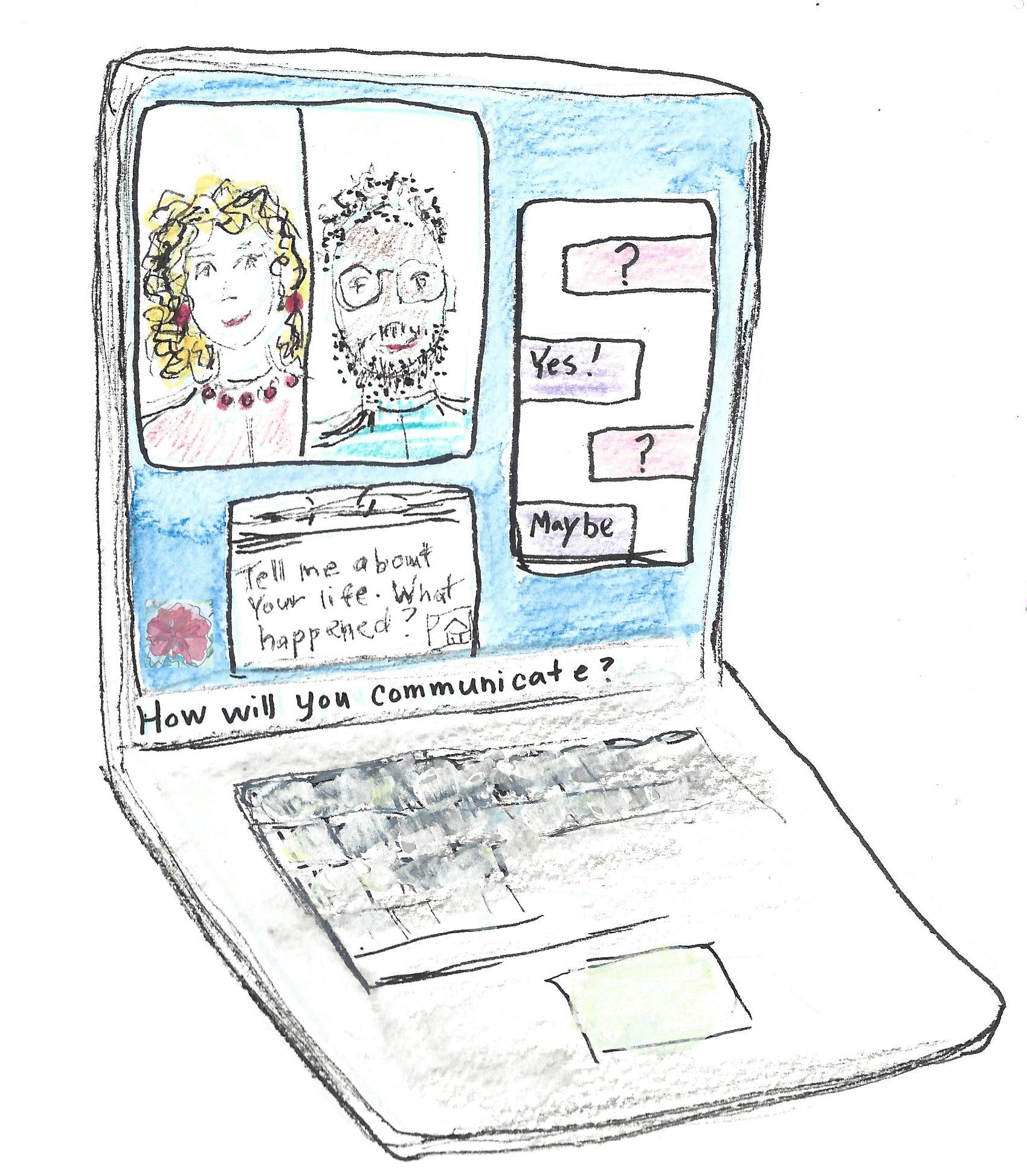
We can communicate online in various ways. Which ones will allow the best contact with participants in your research?
Essential communication: We write, talk, and show.
Whether online or face-to-face communication takes a few basic forms: we write, talk, and show our expressions.
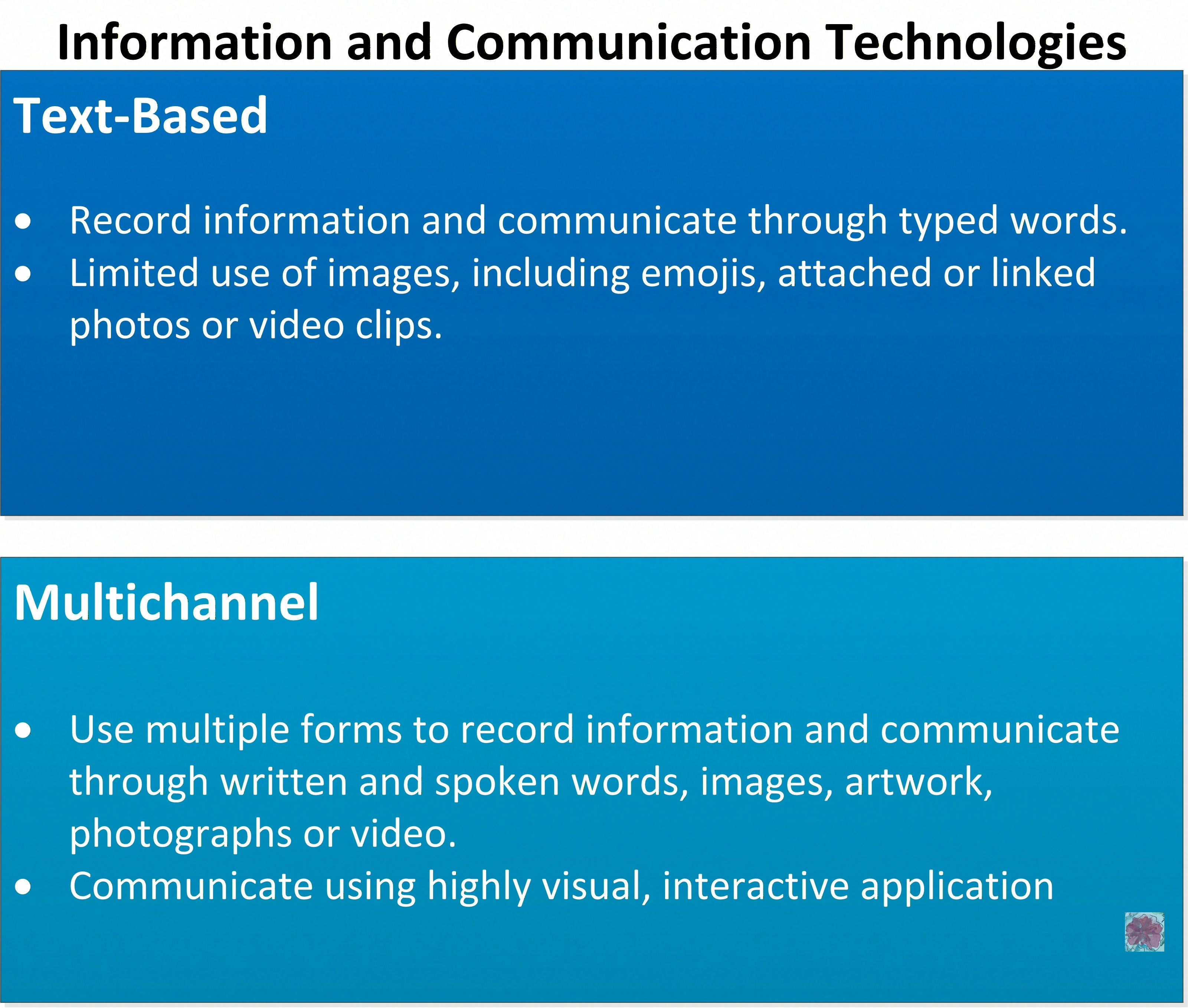
Some ICTs primarily use text. Even when visual elements such as color, emoticons or emoji are added, images or videos embedded, the written word is primary. Other technologies allow for a mix of audio or voice, video, and/or visual communications exchanges. Here these are described as multichannel ICTs.
Two basic types of online communication.
ICTs are generally known by their brand names. Sometimes the brand name becomes a verb when we say “let’s Zoom.” But given the constant changes in the technology industry, and the fact that the same brands are not popular or even available in all parts of the world, we will think about characteristics we need then choose accordingly. Think about your research needs, then look for the platforms and applications that will work for you.
Synchronous, Near-Synchronous and Asynchronous Communication
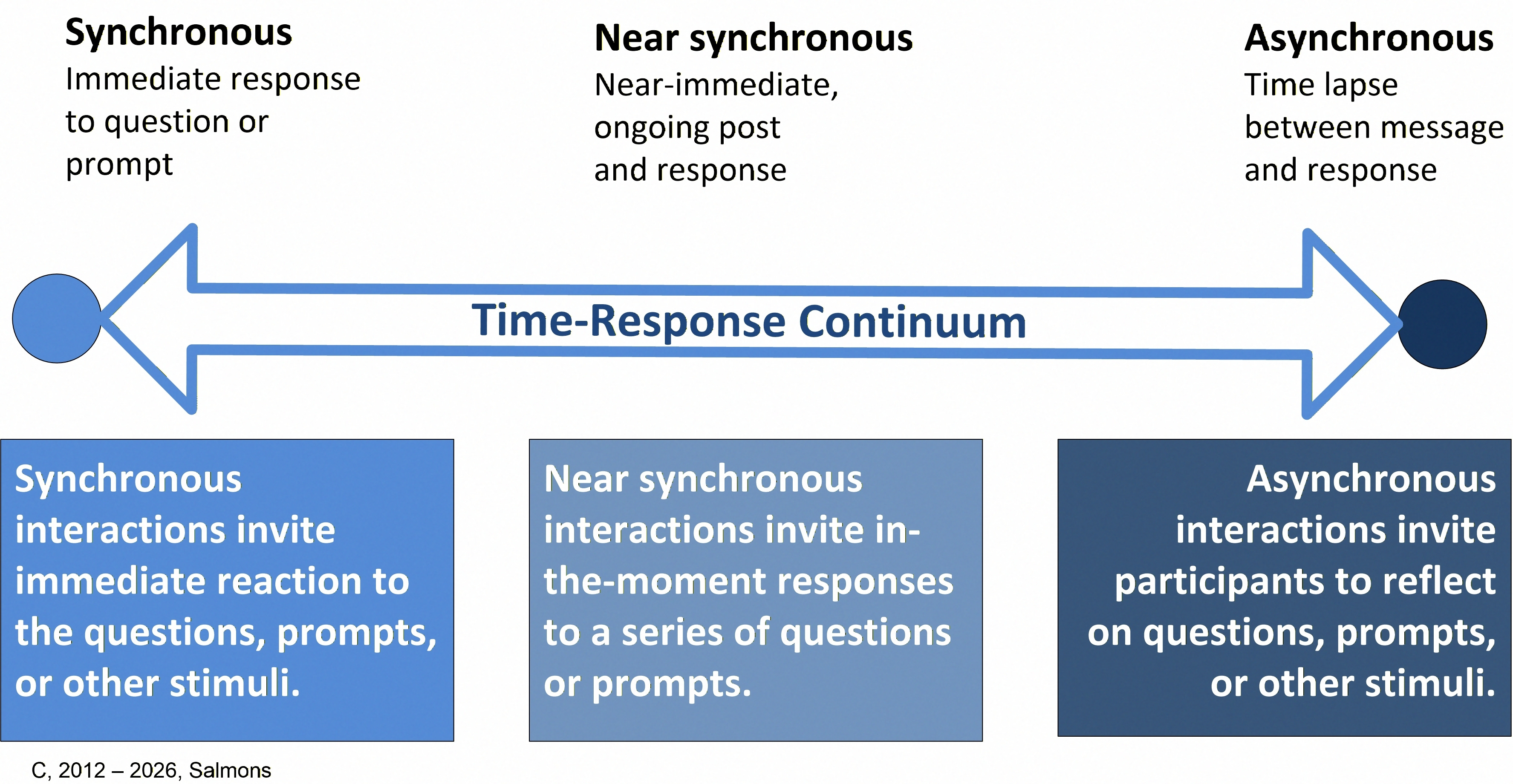
We use text-based and multichannel ICTs in synchronous, near-synchronous and asynchronous ways, meaning we choose the timing of message and response. We can send, receive, and respond to messages at the same time (synchronous communication) or at different times (asynchronous communication). In-person, synchronous real-time communication occurs when people meet or talk on the telephone, and asynchronous communication occurs when they write letters.
Synchronous communications can use ICTs for written, verbal, and/or visual exchange. You can use voice over internet or an app instead of telephone, making it possible to have free conversations with anyone in the world with similar access. With a smartphone or webcam, researchers and participants can see each other while they converse. With shared whiteboards and other tools, you can see, annotate or manipulate diagrams or visual materials while talking with and seeing each other. Or you can interact in immersive 3D virtual worlds or games where researchers and participants are represented by the avatars they design.
Asynchronous communications do not constrain interactions with the need to schedule interactions at the same time. Online asynchronous communications occur when we correspond by email or make posts and respond to others in discussion forums, on social media sites or blogs.
Online communication can be more fluid with what we will call near-synchronous conversations (Salmons, 2012). In near-synchronous communication one party may post, text, or send a comment, update, or question to another with the expectation that the receiving party will respond soon— – the next time he or she is online. Near-synchronous communications may take the form of an extended conversation. The term asynchronous remains a descriptor for communications where there is an expectation of a time gap between message and response.
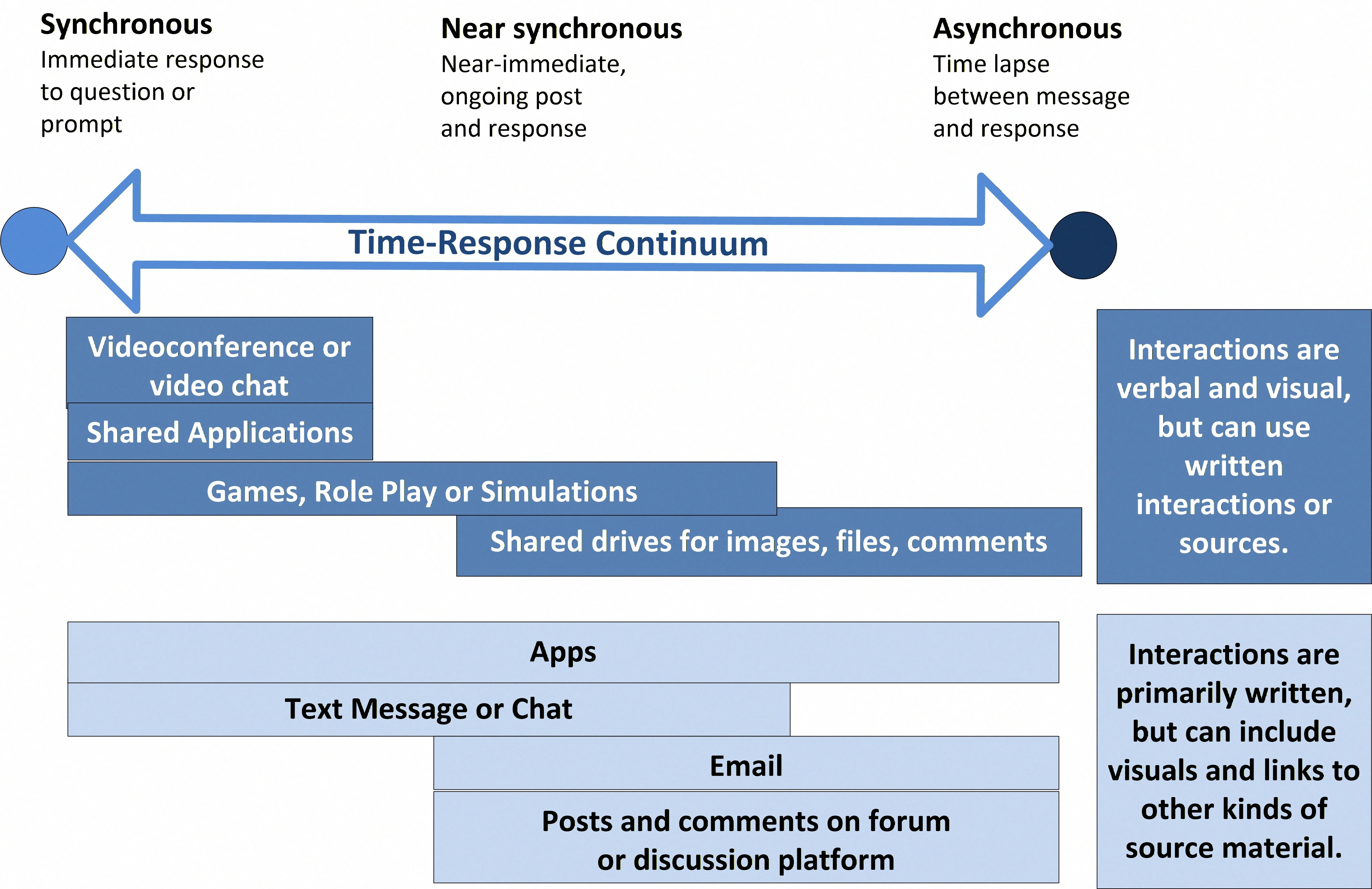
Not always either/or, so let’s use a time-response continuum.
Let’s put these options on a time-–response continuum. This model offers a way to categorize the level of immediacy and timing of response in a way that offers more subtle gradations than the prior synchronous–asynchronous dichotomy. As you can see, some ICTs offer flexibility across the entire continuum while others are more limited. Some offer the potential for synchronous exchange which can be recorded and archived for later comments.
Choosing Time-Response Communications for Your Study
Depending on the ICT(s) you select, it is possible to have synchronous, near-synchronous and asynchronous interactions that are text-based or multichannel.
What kinds of interactions fit your study?
The choice of time–response modes is significant. Do you want to know what is at the top of a participant’s mind right now? Or do you want them to take some time to think about your question or prompt, perhaps gather examples? Or do you want to follow them through the day or week to capture their experiences in the moment?
Researchers typically need multiple exchanges from recruiting, through collecting data, and member checking so you might decide to use a variety of communication tools throughout the study. Every stage should be seen as an opportunity to build trust with, and learn about, the research participant. A mix of synchronous, near-synchronous and asynchronous methods allows for flexibility, variety, and convenience.
If you’ve conducted an online study share your strategies for choosing text-based or multichannel communications with participants.
In the next issue we will look at more considerations for selecting the right ICTs for collecting and storing data.
This license enables reusers to copy and distribute the material in any medium or format in unadapted form only, for noncommercial purposes only, and only so long as attribution is given to the creator. In other words, you can use and share but you do NOT have my permission to upload the newsletter or art to AI.
Thanks to Beth Spencer for this badge, indicating that no AI tools were used to create this post!