
Focus Groups: The Essentials
Learn about focus groups, then design and conduct them online.

We are half-way through 2025, with more on the way. June newsletters about focus groups build on the May series about online interviews:
July-August will continue with this human-to-human research series. Subscribe for the July-August issue about sampling and recruiting for online studies! Use the comment area to suggest topics you’d like me to cover.
One-one interviews have their place as qualitative methods for collecting data, but sometimes we want to collect data from more than one person at a time. We could pose interview questions to a small group, a team or family. Or we could invite a group of selected people to discuss a problem and serve as the moderator. The first is a brief description of a group interview; the second describes a focus group discussion. Each has its purpose. In this newsletter I offer an overview of focus group methods and introduce ways to think about designs for focus groups online. In coming newsletters, I will discuss platforms for group interviews and focus groups and offer examples.
What are focus groups?
Before we can plan an online focus group, we need to know the basics of this method for collecting data. In the Encyclopedia of Research Design Salkind (2017) explains:
The focus group typically consists of a group of participants and a researcher who serves as the moderator for discussions among the group members. In focus groups, there is not always the usual exchange of questions and answers between the researcher and the group that one would commonly envision in an interview setting. Rather, the researcher often ensures that specific topics of research interest are discussed by the entire group in hopes of extracting data and self-disclosure that might otherwise be withheld in the traditional researcher-interviewee environment.
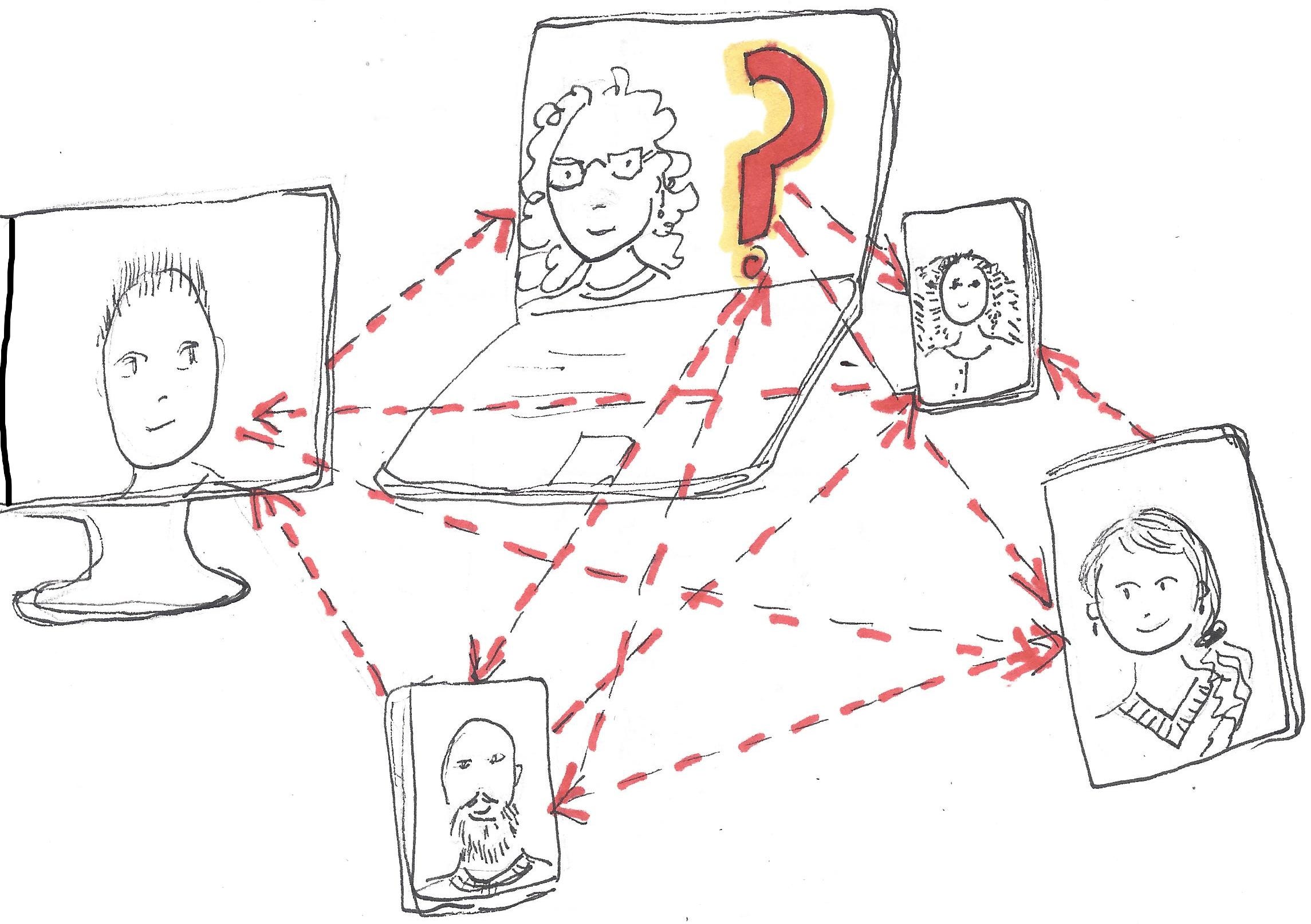
Instead of responding to an interviewer, the main interaction is between participants. They query, comment, agree, chat or argue with each other within the framework set by the researcher and carried out by the moderator. The aim is not consensus or a shared answer, but a nuanced, socially-constructed understanding of the research problem. Stewart and Shamdasani (2015) advocate using focus groups to:
Obtain general background information about a topic of interest.
Stimulate new ideas and creative concepts.
Generate impressions of products, programs, services, institutions, or other objects of interest.
Learn how respondents talk about the phenomenon of interest.
In mixed methods studies, generate research hypotheses that can be submitted to further research and testing using more quantitative approaches or interpret previously obtained quantitative results.
Old school to online focus groups
A few years back a local company that designed and sold travel bags invited me to be a part of a focus group. I’m always interested to see how researchers conduct their studies, and who doesn’t want to be rewarded with a new tote? For this in-person group, participants were seated around the table. A moderator ran the meeting, and we were informed that designers and marketing staff were observing the group from behind a glass wall. Participants shared some characteristics – we all liked to travel – but had varied needs and experiences. One person wanted to carry scuba diving equipment while others were sworn carry-on-only travelers. We were shown examples of different styles and combinations of features. The moderator posed questions and encouraged interaction about important topics like the preferable style of pockets and placement of zippers. Samples were provided so we could feel the fabrics. Participants asked each other questions, gave use-case examples, and built on each other’s comments. The moderator drew out the quiet participants and kept the conversation flowing. She remained non-judgmental and retained an attentive, listening attitude. Given that this focus group was not about sensitive or contentious issues, participation was interesting and fun.
Let’s tease out the characteristics of this conventional focus group and then consider how we could use these methods online in a research context. The essential ingredients were:
A central focus
A moderator
Questions and prompts
Group
Observer(s)
A central focus
Naturally, you need a focus for a focus group! In a research context the focus centers on some aspect of the research problem and aligns with the purpose of the study. Focus groups are an ideal way to unpack complex or multifaceted topics. The focus should be clearly defined and explained in plain, jargon-free terms. Hennink (2014) suggests that researchers identify a limited number of issues, to allow sufficient time to fully discuss each one.
A moderator
The moderator guides, supports and re-directs the discussion according to an outline [or guide] designed on the basis of the research purposes. The moderator establishes a safe, non-threatening environment so all participants are comfortable sharing their perspectives, even if they are at odds with others’ views. The moderator adapts the process to be inclusive of all participants involved.
Moderators – like anyone who works with groups – have their own styles. Still, Liamputtong (2021) suggests that the best moderators are:
Knowledgeable about the research project and how the focus group fits within the overall design
Sensitive to the needs of participants
Respectful of all participants
Non-judgmental about responses
Open-minded
Good listeners
Patient and flexible
Reflexive about the power dynamics (see Reflexivity and Qualitative Research)
Roles are not fixed. The moderator may or may not be the researcher; some researchers might choose to have a trained moderator, especially when multiple groups are being convened. The researcher might choose to observe, so they can focus on listening to the discussion.
Questions and prompts
Focus groups rely on interaction within a group, rather than a question-and-answer format (Acocella & Cataldi, 2021) p. 162. This means we need to think through questions and craft ones that encourage discussion and elicit multiple perspectives.
In a recent newsletter, Do Research Interviews Online, I pointed out that the degree of structure in online interviews relates to the degree of preparation. That is, do you want to determine questions in the moment, in response to participants’ responses or the conversational flow, or do you want to plan out some or all of the questions in advance
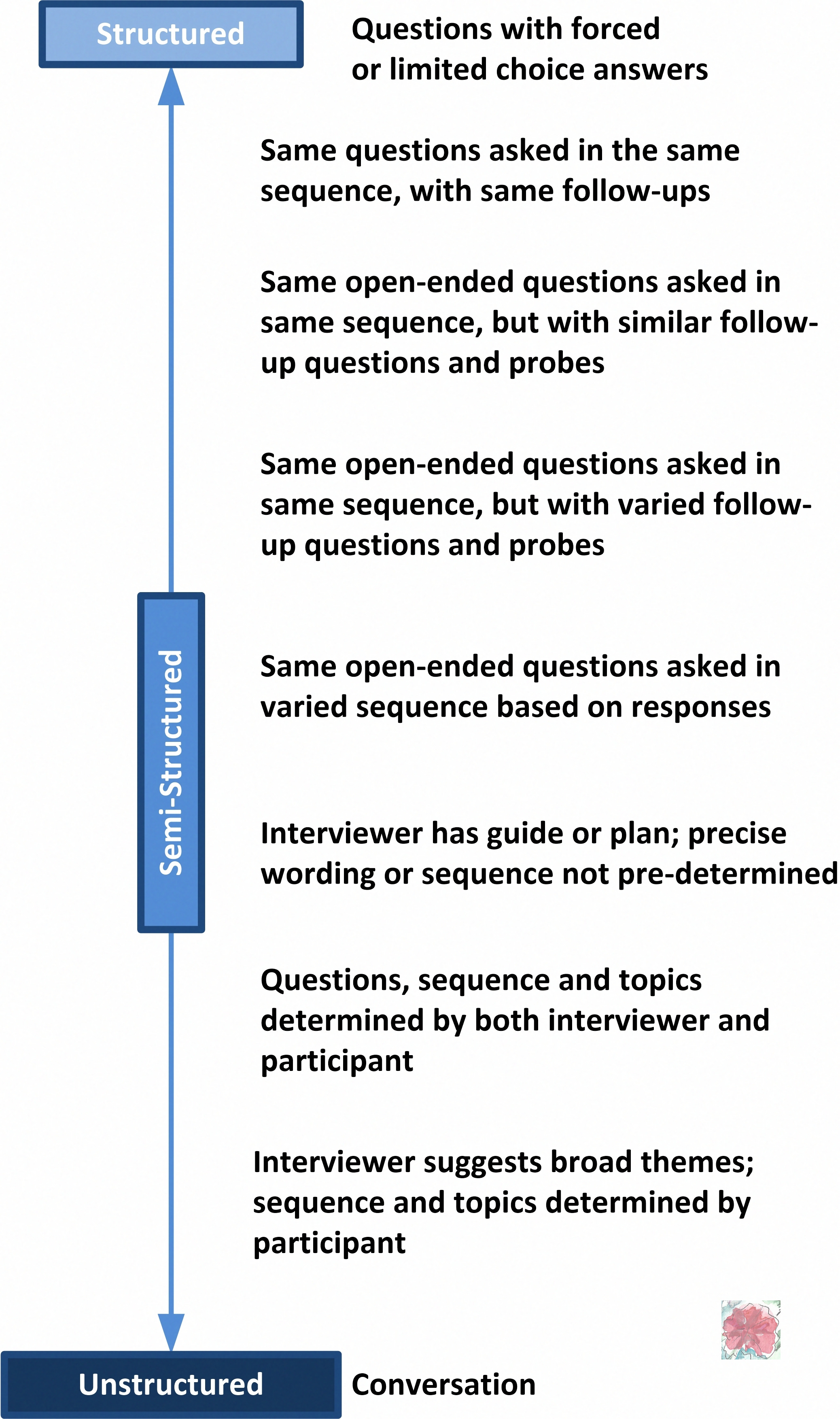
While experienced researchers might be comfortable with an unstructured focus group, some level of structure and preparation might be advantageous. Stewart and Shamdasani (2015) note:
There is, of course, no best answer to this question because the amount of structure and the directness of the moderator must be determined by the broader research agenda that gave rise to the focus groups: the types of information sought, the specificity of the information required, and the way the information will be used.
There is also a balance that must be struck between what is important to members of the group and what is important to the researchers. Less structured groups will tend to pursue those issues and topics of greater importance, relevance, and interest to the group. This is perfectly appropriate if the objective of the researcher is to learn about those things that are most important to the group. Often, however, the researcher has rather specific information needs. (p. 39)
A guide – even an informal one - can help the researcher keep the meeting moving forward. Also, when the study involves multiple focus groups a guide can help retain consistency. (Learn more about structure in this post about online interviews.) The question guide should be outlined and tested – either with a formal pilot test or with colleagues or willing friends. Lay out the sequence and types of questions. Depending on the answers of the participants, moderators can also ask additional questions which are not listed in the interview guide.
Liamputtong (2021) identifies these stages of the focus group process:
The introductory question allows the moderator to generate some knowledge about the participants’ perspectives regarding the issues under investigation.
Transition questions follows gradually from the introductory question. Transition questions narrow down the focus of the discussion and eventually lead to the key questions, which are the core of the research interest.
Closing questions summarize key points that the participants have given during the session. The moderator may say to the participants, for example: ‘I have no more questions to ask but is there anything else you all would like to bring up, or ask about, before we finish this session?’
Liamputtong (2021) identifies these types of questions:
Main questions based on the research problem.
Probing questions prompt the participants to dig more deeply. For example, ‘When did it happen?’, ‘How did it happen?’, ‘Where did it happen?’, ‘How did you get involved in it?’ or ‘What was that like for you?’
Follow-up questions encourage the participants to say more or provide more specifics.
Direct questions are asked to clarify issues in the participants’ responses.
Indirect questions can help participants discuss sensitive issues or more personal views. For example, the moderator could ask ‘what do most people think about _____?” and then ask, “is that your experience too?”
Group
It is hard to have a group discussion without a group! In my example, participants shared key characteristics, but were diverse in other regards. The degree of homogeneity or heterogeneity of your ideal group will depend on the nature and purpose of the study. Subscribe for the July-August issue about sampling and recruiting for online studies!
Observer(s)
Some focus groups engage observers or involve the researcher or members of the research team in observation. Observers follow the dynamics of the group and identify data points to delve into at the analytic stage. Acocella and Cataldi (2021) emphasize the importance of having someone observe the focus group:
Observation of the interaction among the participants requires continuous attention, which the moderator – engaged in other tasks – cannot guarantee. For this reason, present during each meeting must be a person who devotes himself/herself exclusively (or at least predominantly) to this activity. To do so properly, he/she must have a profound knowledge of group dynamics. (pp. 69 – 70)
They suggest that the observation should serve two main purposes:
Evaluate whether the information has been invalidated by particular group dynamics. During a focus group, dynamics of conformism and attitudes of acquiescence can arise, as well as subjugation or extreme conflict. These dynamics may strongly influence the discussion, and compromise the degree of fidelity of the answers provided.
Give different degrees of importance to the topics dealt with. The various participants will not address in the same way and with the same intensity all themes. Since the focus group unit of analysis is not the individual participants but rather the group as a whole, every single intervention cannot be extrapolated from the general group discourse. Indeed, the purpose is to acquire full meaning in the general framework of a collective signification.
Online focus groups
As with anything carried out via the internet, online focus groups are the same but different from their face-to-face live counterparts. In the next newsletter we will explore how to adapt and apply these ideas to design and conduct focus groups using online platforms or apps to connect with participants.
References
Acocella, I., & Cataldi, S. (2021). Outlining the focus group. In Outlining the Focus Group (Vol. 0, pp. 3-30). Sage Publications Ltd, https://doi.org/10.4135/9781529739794.n1
Hennink, M. M. (2014). Focus group discussions. Oxford: Oxford University Press.
Liamputtong, P. (2011). Conducting focus groups and practicalities. In Conducting focus groups and practicalities (pp. 71-86). SAGE Publications Ltd, https://doi.org/10.4135/9781473957657.n5
Salkind, N. J. (2010). Encyclopedia of research design (Vols. 1-0). Thousand Oaks, CA: Sage Publications, Inc. doi: 10.4135/9781412961288
Stewart, D. W., Shamdasani, P. N., & Rook, D. W. (2015). Focus groups and the research toolbox. In Focus groups and the research toolbox (3rd ed.) Sage Publications, Ltd.
Learn more!
Find more details about the use of focus groups in qualitative research in these open-access articles.
Methods
Hofmeyer, A. T., & Scott, C. M. (2007). Moral Geography of Focus Groups with Participants Who Have Preexisting Relationships in the Workplace. International Journal of Qualitative Methods, 6(2), 69-79. https://doi.org/10.1177/160940690700600207 (Original work published 2007)
Abstract. Focus group interviews have become increasingly popular in the past three decades, but ethical issues related to conducting focus groups with participants who have preexisting power relationships in workplaces has received scant attention in the methodological qualitative literature. In this paper the authors offer three propositions to strengthen the moral geographical space between researchers and participants.
Onwuegbuzie, A. J., Dickinson, W. B., Leech, N. L., & Zoran, A. G. (2009). A Qualitative Framework for Collecting and Analyzing Data in Focus Group Research. International Journal of Qualitative Methods, 1–21. https://doi.org/10.1177/160940690900800301
Abstract. Despite the abundance of published material on conducting focus groups, scant specific information exists on how to analyze focus group data in social science research. Thus, the authors provide a new qualitative framework for collecting and analyzing focus group data.
Peterson, M. (2020). Objects in focus groups: Materiality and shaping multicultural research encounters. Qualitative Research. https://doi.org/10.1177/1468794120968735
Abstract. This paper discusses some opportunities and challenges of using objects in focus groups, to explore multicultural encounters and experiences of living together. Drawing on feminist approaches to human embodiment, it argues that material approaches hold the potential to investigate the embodied and relational experiences of encounters with/across difference of diverse participants in sensitive ways.
Propst, D. B., McDonough, M. H., Vogt, C. A., & Pynnonen, D. M. (2008). Roving Focus Groups: Collecting Perceptual Landscape Data in Situ. International Journal of Qualitative Methods, 7(3), 1-14. https://doi.org/10.1177/160940690800700301 (Original work published 2008)
Abstract. Although focus groups are adaptable to unique situations, experts warn that the physical environment in which discussions take place should (a) be free from distractions, (b) be neutral, and (c) permit participants to face each other. In 2004 and 2005 the authors experimented with roving focus groups in the rural landscape of Michigan (USA). As they moved along in a vehicle, participants discussed features that contributed to and detracted from rural landscape character.
Moderation and Researchers’ Roles
Archer, Thomas M. (2007) "Using Guidelines To Support Quality Moderation of Focus Group Interviews," Mid-Western Educational Researcher: Vol. 20: Iss. 1, Article 10. Available at: https://scholarworks.bgsu.edu/mwer/vol20/iss1/10
Abstract. A Focus Group Interview (FGI) involves 6-9 people guided through a pre-thought line of questioning for 1-2 hours by a trained Moderator. The Moderator gives participants the opportunity to express ideas, thoughts, and views. This is a robust qualitative data collection method IF there is a skilled FGI Moderator. The Moderator sets the tone, delivers a high quality introduction, makes the discussants feel trusting, while at the same time managing a set of unstructured questions discussed by a mix of personalities within a relatively short time. The Moderators’ Code is a set of ten guidelines for moderating successful FGIs.
Grønkjær, M., Curtis, T., de Crespigny, C., & Delmar, C. (2011). Analysing group interaction in focus group research: Impact on content and the role of the moderator. Qualitative Studies, 2(1), 16–30. https://doi.org/10.7146/qs.v2i1.4273
Abstract. Interaction between group participants is considered the distinct advantage and hallmark of focus group research. It is therefore necessary to include the social interaction dynamics in analysing focus group data. Little information is however available on analysis of the social interaction in the group and the analytical outcome for the content of the data. This paper contributes to the discussion of the value of participant interaction in focus group research by analysing sequences of interaction collected recently during a research project.
Roald, G. M., Schruijer, S., & Neergård, G.-B. (2024). The Researcher’s Facilitating Role in Stimulating a Constructive Group Climate in Online Focus-Group Interviews. Qualitative Inquiry, 0(0). https://doi.org/10.1177/10778004241260656Z
Abstract. The purpose of this article is to examine the role of the researcher in stimulating a constructive group climate in online focus-group interviews. It is argued that a climate of psychological safety enhances the likelihood of people expressing their true opinions and thoughts regarding the topic at hand, which is a crucial quality of focus-group research. However, these aspects are more difficult to develop in online encounters than face-to-face. We therefore look into how the researcher can work to acquire focus-group data of adequate quality from online focus-group interviews. Based on an analysis of the research literature on focus-group interviews, as well as group development theory and person-centered theory, we propose three main strategies for researchers who conduct online focus-group interviews: (a) creating conditions before the interview; (b) creating conditions at the beginning of the interview; and (c) active interventions during, and at the end of, the interview.

This license enables reusers to copy and distribute the material in any medium or format in unadapted form only, for noncommercial purposes only, and only so long as attribution is given to the creator. In other words, you can use and share but you do NOT have my permission to upload the newsletter or art to AI.

Thanks to Beth Spencer for this badge, indicating that no AI tools were used to create this post!