
Ethical Research Across Boundaries
More questions to consider!

When I was designing my doctoral research I knew I wanted to learn from participants across the world, but lacked the funds to travel. While online research was just getting started at that time, it was immediately apparent that conducting interviews via videoconference was the answer to my problem. Clearly, one of the advantages of online research is the ability to cross boundaries. It seems so simple! Just log in! Actually, we need to give careful thought to ethical practices whether we interact electronically or in-person with participants in communities and cultures different from our own.
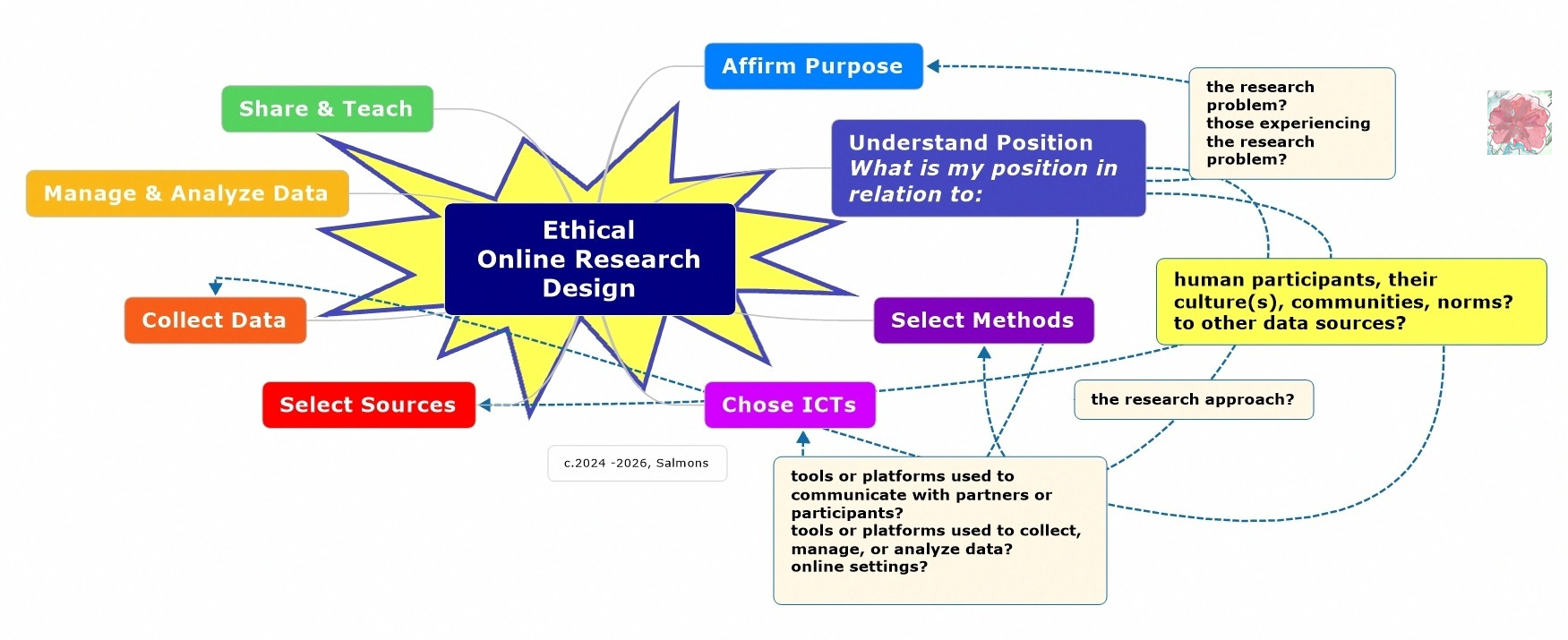
How different? Different how?
In an earlier newsletter in this series on ethics and research in a digital age, I suggested that we need to be self-aware about the ways in which we are insiders or outsiders in relation to the study. Certainly there are situations where we fully inside the study (such as autoethnography) or entirely outside the study. But more often our positions are somewhere in between. We might share some characteristics with the people we want to study, but not all. We might live in cultures and communities that share some characteristics to the places where participants reside, but not all. We might discover that power and privilege differentiates us from participants.
While researchers who are insiders of a community or culture can certainly act unethically, when we are outsiders, we might do so unintentionally. Without careful efforts the study we thought would build understanding might not achieve its aims, and even worse, cause harm.
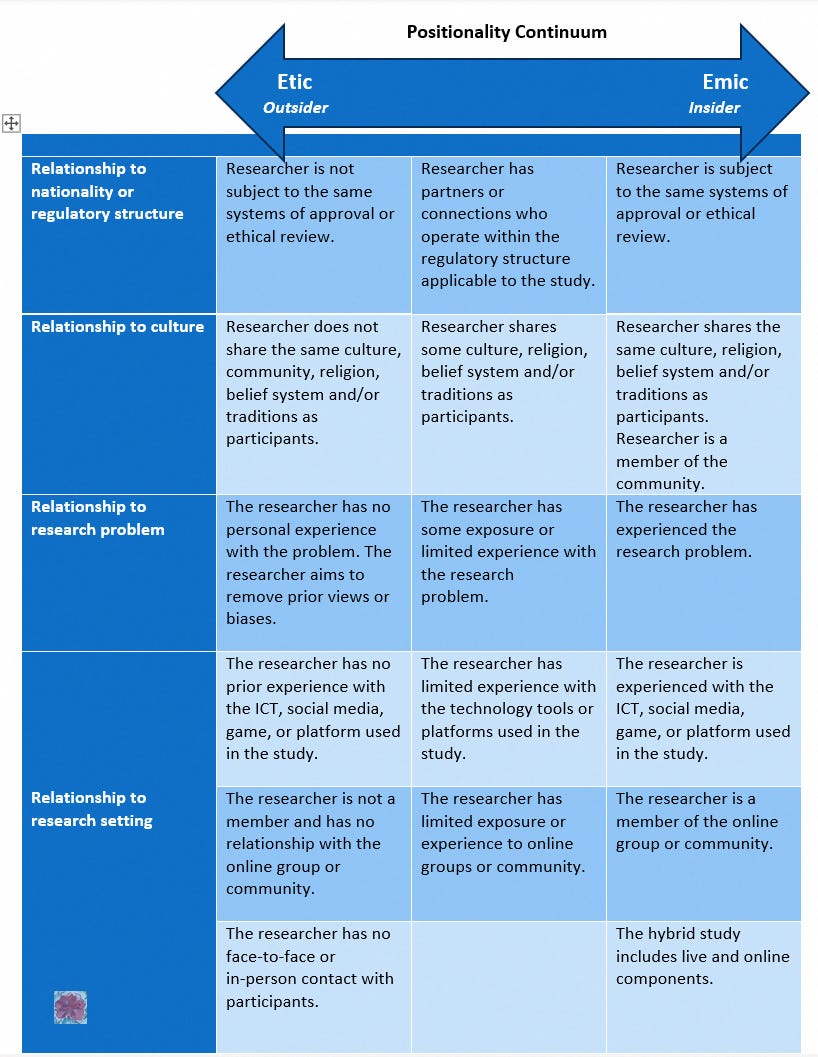
Clearly positionality is tied to research ethics and integrity in ways we can’t ignore. These issues might be minor in studies that are not about personal, political or touchy topics. Or the situation might be much more complex when we want to carry out an international, cross-cultural, multilingual study on sensitive topics.
Importantly, allow time for reflexive self-awareness and for the due diligence necessary to learn about people and settings (real and virtual) relevant to your study.
The TRUST Code: A Global Code of Conduct for Equitable Research Partnerships
For respected guidance on these matters, I’d like to draw your attention to the TRUST Code (2018), the open-access book, Equitable Research Partnerships: A Global Code of Conduct to Counter Ethics Dumping (2019), and follow-up TRUST Code Supplement (2025.) Researchers who want to study Indigenous peoples in Southern Africa can consult the San Code of Research Ethics.
Learn how to apply the TRUST code with “The TRUST Code in 60 Minutes”. Note that the TRUST Code translations are available for download on the website. These great materials are all open-access, so share them with your colleagues and students!
The Trust Code and Supplement focus on four important areas:
Fairness
Respect
Care
Honesty
While the code was written to specifically address issues researchers from high-income countries should consider when doing field research in lower-income countries, the principles apply in any situation where there are “imbalances of power, resources and knowledge.” They do not focus on research conducted online, the principles broadly apply. In some ways online researchers need to be even more attentive to positionality and cultural sensitivities, because we do not have the informal time in physical settings that allows us to learn about community expectations.
Learn more!
Chatfield, K., Lightbody, C. E., Qayum, I., Ohly, H., Rasgado, M. C., Watkins, C., & Lowe, N. M. (2022). Can an ethics code help to achieve equity in international research collaborations? Implementing the global code of conduct for research in resource-poor settings in India and Pakistan. Research Ethics, 18(4), 281-303.
Abstract. The Global Code of Conduct for Research in Resource-Poor Settings (GCC) aims to stop the export of unethical research practices from higher to lower income settings. Launched in 2018, the GCC was immediately adopted by European Commission funding streams for application in research that is situated in lower and lower-middle income countries. Other institutions soon followed suit. This article reports on the application of the GCC in two of the first UK-funded projects to implement this new code, one situated in India and one in Pakistan. Through systematic ethics evaluation of both projects, the practical application of the GCC in real-world environments was tested. The findings of this ethics evaluation suggest that while there are challenges for implementation, application of the GCC can promote equity in international research collaborations.
Coningham, R., Lewer, N., Acharya, K. P., Weise, K., Kunwar, R. B., Joshi, A., & Parajuli Khanal, S. (2024). Enabling equitable and ethical research partnerships in crisis situations: Lessons learned from post-disaster heritage protection interventions following Nepal’s 2015 earthquake. Research Ethics, 20(4), 835-846.
Abstract. The earthquakes which struck Nepal’s capital in 2015 were humanitarian disasters. Not only did they inflict tragic loss of life and livelihoods, they also destroyed parts of the Kathmandu Valley’s unique UNESCO World Heritage site. These monuments were not just ornate structures but living monuments playing central roles in the daily lives of thousands, representing portals where the heavens touch earth and people commune with guiding deities. Their rehabilitation was also of economic importance as they represent a major source of tourist income and employment. Unfortunately, the social and political desire for rapid reconstruction resulted in the swift removal of many traditionally constructed foundations and their replacement with modern materials without assessments of whether they contributed towards the collapse of individual monuments. These actions, combined with the wholesale removal, mixing and dumping of modern and historic debris, contributed to a second, equally destructive, cultural catastrophe – irreversible damage to Kathmandu’s Medieval fabric, in a process which frequently excluded local communities and custodians. This case study draws from our collective reflections and lessons learned from our attempts to enable equitable and ethical research partnerships between UK and Nepali colleagues as well as local communities in the debris of the Kasthamandap, Kathmandu’s eponymous monument. After briefly describing the potential of mobilising archaeologists in post-disaster contexts and outlining the challenges of undertaking research in such a setting, our case study utilises the TRUST Code to assess the character and success of our multidisciplinary collaboration in a time of crises.
Newsletters about Research and Ethics
Ask those experiencing the research problem before designing a study
Choose privacy for online research
Don’t want to commit to a paid subscription? You can still support my work! Buy me a cup of tea.
What’s next?
It is summer in my part of the world, and that means time to enjoy time in the mountains! In August we will take a different tact. I will share one (maybe more!) newsletter focused on ways to illustrate your writing, whether formal academic articles or informal posts, without using AI tools. You don’t want to miss this demonstration and how-to so
if you aren’t a subscriber, jump in! Also keep in mind that paid subscribers can request a 1-1 session to discuss or critique your work.

This license enables reusers to copy and distribute the material in any medium or format in unadapted form only, for noncommercial purposes only, and only so long as attribution is given to the creator. In other words, you can use and share but you do NOT have my permission to upload the newsletter or art to AI.

Thanks to Beth Spencer for this badge, indicating that no AI tools were used to create this post!